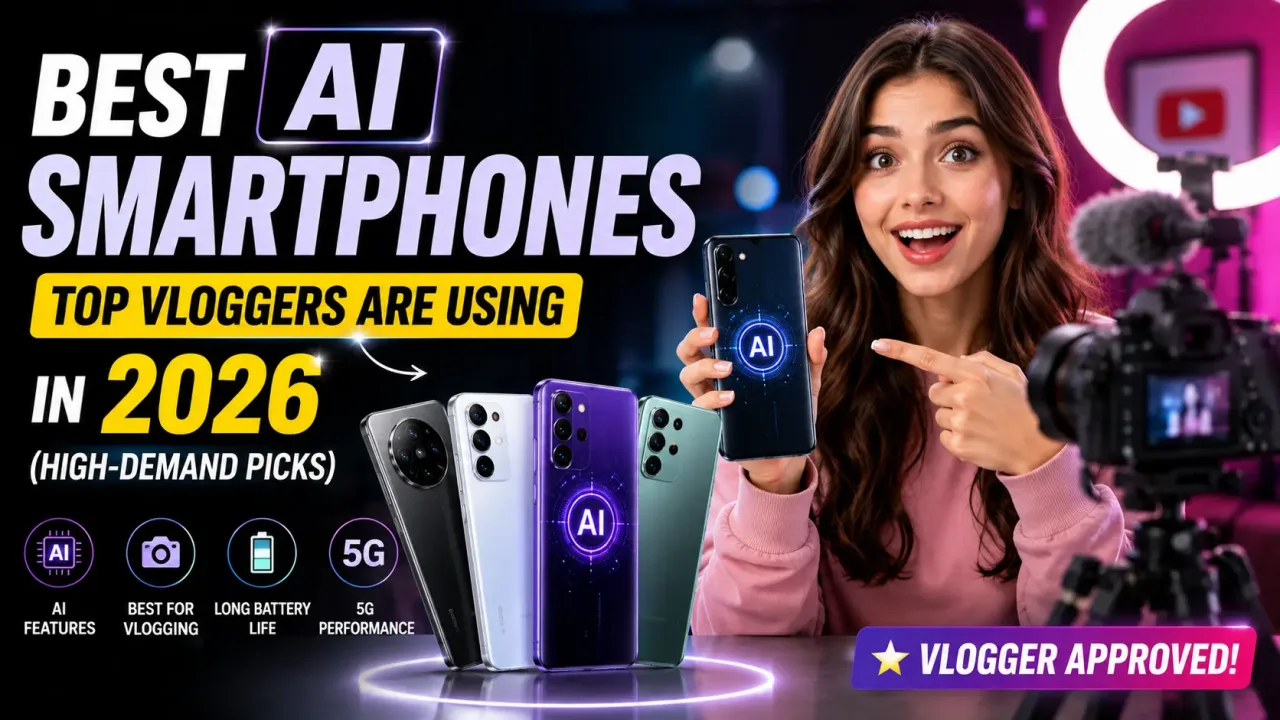
Best AI Smartphones for Content Creators in 2026: Must-Have Picks
What this article covers
Picture your last content-creation Sunday. You've got footage from three different locations, a client deadline breathing down your neck, a battery that's somehow already at 40%, and an editing app that's chugging along slower than you'd like. Sound painfully familiar? If you create content regularly, your smartphone isn't just a phone anymore — it's your camera, your editing suite, and your upload station, all rolled into one device that better not let you down mid-shoot.
The good news is that 2026's smartphone lineup has genuinely leveled up when it comes to AI-powered content creation tools. We're not talking about gimmicky filters here — we're talking about on-device processing that saves real editing time, camera systems that handle tricky lighting without you fussing over manual settings, and batteries built to survive an actual full day of shooting. Let's walk through which phones are genuinely worth your money this year, and why.
What Actually Matters When Choosing a Creator Phone#
Before jumping into specific picks, it helps to know what to actually look for, because spec sheets can get overwhelming fast. A YouTube or content-creation phone needs to record sharp, clear video with good stabilization, accurate colors, and strong low-light performance — those fundamentals matter more than almost anything else on the list.
Beyond that, good microphones matter enormously for clear audio, since poor sound quality can drag down even beautifully shot footage. Content creation also drains batteries fast, so a large battery paired with fast charging isn't a luxury — it's essential if you're recording for hours at a stretch. And because video eats up storage shockingly quickly, with a single minute of 4K footage at 60fps consuming roughly 400MB, anyone shooting frequently or producing longer-form content should seriously consider a phone with at least 512GB, ideally more.
iPhone 16 Pro Max — Still the Reliable All-Rounder#
Let's start with the phone most creators already know well. The iPhone 16 Pro Max continues to be recommended as the most reliable all-around choice for creators, delivering strong video quality, smooth editing performance, and the longest software support timeline in the industry.
What keeps pulling creators back to this phone isn't flashy AI marketing — it's consistency. Apple's Smart HDR and Deep Fusion processing merge the best details from multiple exposures rapidly, producing results that traditional standalone cameras genuinely struggle to match in similar conditions. If your workflow already lives inside Final Cut Pro or the broader Apple ecosystem, this remains the safest, most dependable choice you can make, especially since transferring files between your phone, laptop, and other Apple devices through AirDrop remains refreshingly frictionless.
Samsung Galaxy S26 Ultra — The AI Powerhouse for Android Creators#
If you're firmly in the Android camp and want the most capable creator phone available, the Galaxy S26 Ultra deserves serious attention. It's Samsung's latest flagship, and it comes absolutely loaded with computational AI features — including the ability to generate intermediate frames for already-recorded footage, effectively creating smooth slow-motion clips after the fact, and AI tools that noticeably improve audio quality during editing.
The S Pen adds a layer of practical convenience too, letting you handle precise video trimming, write captions directly on screen, or control your camera remotely during solo shoots — small conveniences that genuinely add up across a full day of content creation. If you shoot frequently in outdoor bright light, though, it's worth knowing the screen can still struggle a bit compared to iPhones in direct sunlight, so that's a fair trade-off to weigh.
Google Pixel 10 Pro XL — Best for AI-Driven Simplicity#
For creators who want intelligent automation without fussing over dozens of manual settings, the Pixel lineup continues to lean into what Google does best — genuinely useful AI that simplifies your workflow instead of complicating it. Gemini-powered tools like Magic Editor have been praised for saving real editing time, letting you make meaningful adjustments without opening a separate desktop app.
If storage is a priority for you specifically, the Pixel 9 Pro XL offers up to 1TB of space, giving serious creators the flexibility to shoot extended footage without constantly offloading files mid-project. And for creators who value a clean, bloatware-free Android experience combined with long-term software updates, this lineup remains one of the most approachable entry points into Android, especially for anyone transitioning away from iOS for the first time.
OnePlus 13 — The Speed-Focused Pick#
If your biggest frustration is charging downtime eating into your shooting schedule, OnePlus has built a genuine reputation around blazing-fast charging technology that can take a battery from empty to full in a remarkably short window. For creators juggling back-to-back shoots with barely any break in between, that alone can be a genuine game-changer.
Beyond charging speed, OnePlus phones have also earned a reputation for handling smartphone editing workloads impressively fast, particularly when paired with generous RAM configurations that keep heavier editing apps running smoothly without the usual lag or app-switching delays.
Nothing Phone (3a) Pro — Best Budget Pick That Doesn't Feel Budget#
Not every creator has flagship money to spend, and that's completely fine. The Nothing Phone (3a) Pro has earned a strong reputation for punching well above its price class, offering a genuinely impressive front camera and a periscope telephoto lens that most budget phones simply don't bother including.
If you're just starting your content creation journey and don't want to sink a huge chunk of savings into a phone before you even know your niche, this is a genuinely smart way to get quality results without the flagship price tag attached.
A Quick Word on Ecosystem Compatibility#
Here's something worth thinking through honestly before you buy anything — your phone doesn't exist in isolation. If you're deeply embedded in Apple's ecosystem with a MacBook, iPad, and AirPods, jumping to Android can introduce friction even if the AI camera features genuinely impress you on paper. Similarly, if you've built your entire editing workflow around Android-native apps and cross-device flexibility, forcing yourself into iOS just because everyone else seems to use it isn't necessarily the smartest move either.
The right ecosystem fit often matters just as much as the raw hardware specs, especially when you're moving footage between multiple devices daily.
Final Thoughts#
There isn't one single "best" AI smartphone for every content creator in 2026 — and honestly, that's a good thing. Whether you gravitate toward the dependable consistency of the iPhone 16 Pro Max, the AI-loaded versatility of the Galaxy S26 Ultra, the simplicity of Google's Pixel lineup, the charging speed of OnePlus, or the budget-friendly punch of the Nothing Phone (3a) Pro, what matters most is matching the phone to how you actually create content, not just chasing the flashiest spec sheet.
So before you swipe your card on the priciest flagship, take a moment to think honestly about your own workflow — your shooting conditions, your editing habits, your storage needs, and your existing ecosystem. Get that alignment right, and whichever phone you choose will feel less like a purchase and more like a genuine upgrade to how you create.

Read next
High Performance AI Laptops Under Rs 40k for Graphic Designing in 2026
Let's have an honest conversation before diving into recommendations, because you deserve honesty more than hype. If you've been searching for a "high-performance…

These 10 Newly Launched AI Gaming Laptops Have Changed Gen Z’s Gaming Forever
Think back to the last time you watched someone crank up a demanding game on an old laptop, only to see it chug through 30 fps like it…
Why Top YouTubers Ditch iPhones for This Hidden AI Phone in 2026
If you've spent years assuming that "serious content creator" automatically means "iPhone in hand," you're definitely not alone. For the longest time, that pairing…
High-Rated Newly Launched AI Laptops Top Video Creators Are Using (Nobody’s Talking About)
Scroll through any "best laptop for creators" list online, and you'll notice something a little repetitive — the same handful of names keep popping up over and…
0 comments